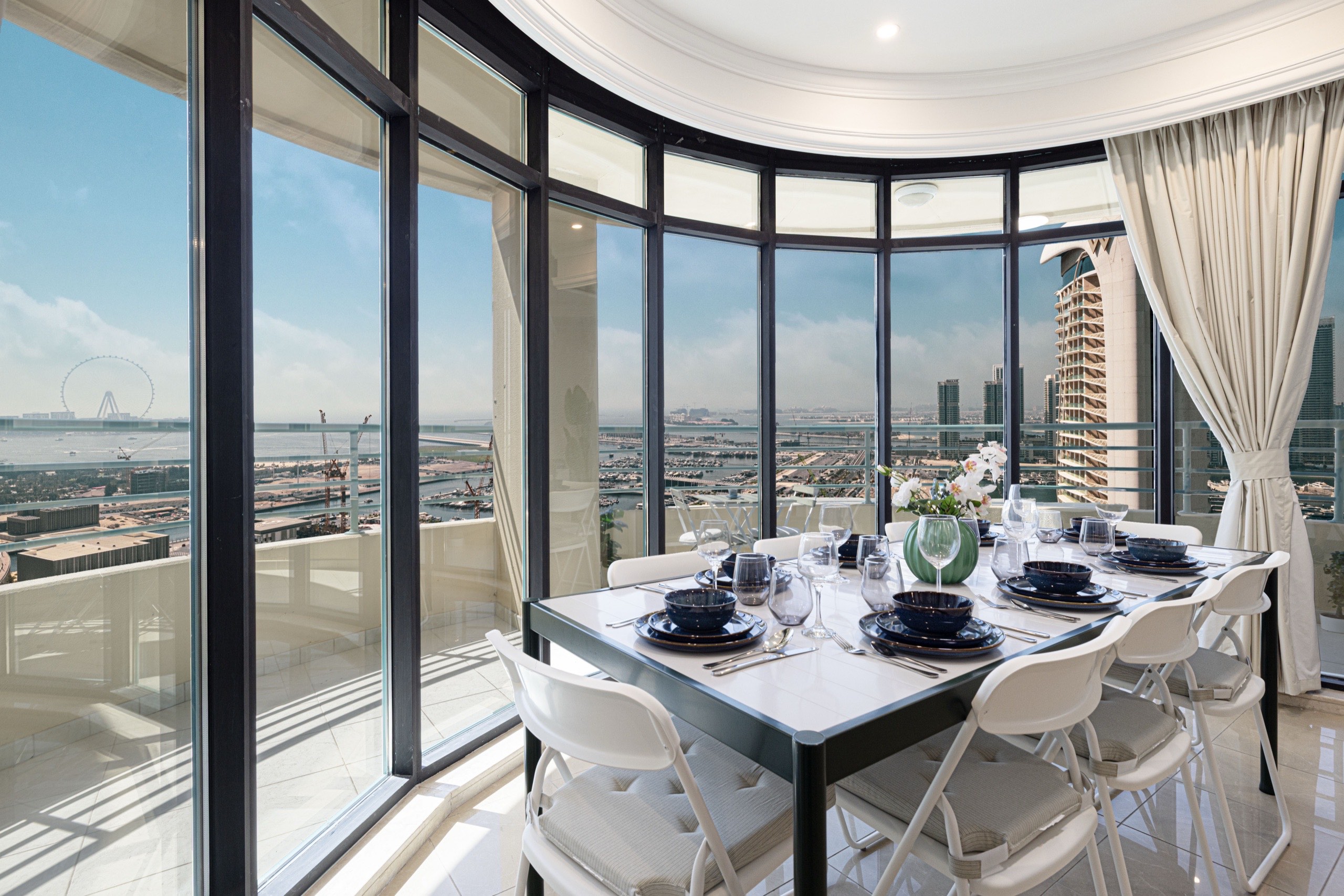
The "+172%" doing the rounds about Dubai's short-term rental market in 2026 measures the market's total revenue, all properties added together. Per property, revenue per available night rose 14.7% on the same AirDNA dataset; on AirROI, annual revenue per listing fell 27.6% while supply grew 86.6%.
What does the "+172%" in Dubai short-term rental revenue measure?
The figure comes from AirDNA data published by Emirates 24|7 on 4 September 2026, covering the 12 months to the end of August 2026. AirDNA calculates a total market revenue of AED 2.582 billion: the average annual revenue of one unit (AED 136,600) multiplied by the number of units measured (18,902). That total rose 171.9% year on year.
A market total grows in two ways: each unit earns more, or more units are counted. The same dataset shows the weight of each effect:
- Revenue per available night (RevPAR, the average nightly rate multiplied by the occupancy rate): +14.7%.
- Occupancy rate (the share of available nights actually booked): +24.2%.
- Total revenue: +171.9%.
Flatlab's calculation: 2.719 divided by 1.147 gives 2.37. If revenue per available night only rose 14.7%, the number of available nights measured was multiplied by about 2.4 in a year. The dataset does not say whether that growth comes from new units or from a wider measurement scope. Either way, the "+172%" describes the size of the market. Your property's income shows in RevPAR, which is explained in our guide to ADR, occupancy and RevPAR.
Two details from AirDNA complete the picture: the AED 136,600 per unit is before the owner's expenses, and it includes cleaning fees paid by the guest.
Dubai rental market 2026 indicators, source by source
Three data providers and the Department of Economy and Tourism (DET) publish figures for the period. Each row keeps its source and date: the scopes differ and the figures do not add up.
| Indicator | Value | Year-on-year change | Source | Period or date |
|---|---|---|---|---|
| Units measured | 18,902 | not published | AirDNA (via Emirates 24|7) | 12 months to end Aug 2026 |
| Occupancy rate | 69% | +24.2% | AirDNA (via Emirates 24|7) | 12 months to end Aug 2026 |
| ADR (average price per booked night) | AED 654 ($178) | not published | AirDNA (via Emirates 24|7) | 12 months to end Aug 2026 |
| RevPAR | AED 451 ($123) | +14.7% | AirDNA (via Emirates 24|7) | 12 months to end Aug 2026 |
| Average annual revenue per unit, before expenses | AED 136,600 | not published | AirDNA (via Emirates 24|7) | 12 months to end Aug 2026 |
| Total market revenue | AED 2.582 billion | +171.9% | AirDNA (via Emirates 24|7) | 12 months to end Aug 2026 |
| Active listings | 20,018 | +86.6% | AirROI | Aug 2025 to Jul 2026 |
| Occupancy rate | 39.9% | not published | AirROI | Aug 2025 to Jul 2026 |
| Annual revenue per listing | $20,441 | -27.6% | AirROI | Aug 2025 to Jul 2026 |
| Airbnb listings | 24,007 | not published | GuestFavorites | Oct 2025 to Sep 2026 |
| Occupancy rate and ADR | 69% and AED 739 | not published | GuestFavorites | Oct 2025 to Sep 2026 |
| Hotel occupancy | 36% in March, 66% in August | August: 89% of August 2025 level | DET (via Gulf News) | January to August 2026 |
| International visitors | 6.97 million | not published | DET (via Gulf News) | January to August 2026 |
Read together, the figures show three things:
- Supply is growing faster than revenue per unit. AirROI measures 86.6% more listings and revenue per listing down 27.6%.
- Occupancy varies by a factor of almost two depending on the source: 69% on AirDNA and GuestFavorites, 39.9% on AirROI. Scopes and platforms covered differ.
- Hotels have not returned to 2025 levels: in August 2026, hotel occupancy stood at 89% of August 2025.
How the regional conflict affected short-term rentals in Dubai
On 28 February 2026, the regional escalation cut part of the air traffic into the UAE. According to AirDNA data presented by Skift on 9 March 2026, 90,000 nights were cancelled in the UAE in a single week, against about 19,000 in a typical week, and gross nights booked fell 30%. DET recorded hotel occupancy of 36% in Dubai in March.
Recovery is under way, unevenly. According to AirDNA data reported by Skift on 2 September 2026, across the UAE:
- Occupancy in the third quarter rose about 4%, while booked nights stayed about 13% below last year.
- Available listings fell nearly 5% in July, as hosts pulled out after months of weak returns.
- Apartment ADR was still down 7% in July, while villa ADR rose 12.2%.
- Dubai Marina and JBR, close to Jebel Ali Port, lost guests to areas further inland.
- Stays of 28 nights or more increased, as some hosts switched to mid-term lets.
- Early fourth-quarter ADR was running 17% ahead of last year.
For an owner, the first point matters most: occupancy can rise while demand falls, when listings leave the market. Booked nights measure demand; the occupancy rate also reflects supply. The breakdown for the Marina, JBR and Dubai Harbour is in our Marina, JBR and Dubai Harbour comparison.
The May 2026 support package: what changes in holiday home costs
On 21 May 2026, the Dubai Media Office announced a second economic incentives package of AED 1.5 billion, bringing the total to AED 2.5 billion together with the first AED 1 billion package approved in late March. For short-term rentals, two measures concern owners:
- Exemption from holiday home permit and licence fees.
- Exemption from collecting the Tourism Dirham (the fee per occupied room per night, paid by the guest) for registered establishments.
The package runs over 3 to 12 months, and each government entity sets the timeline of its own measure. The amount actually due appears on DET's payment link when you apply or renew. Standard fees and the application process are set out in our Dubai holiday home permit guide.
The effect on income is limited: a permit for a studio or one-bedroom costs AED 370, and the Tourism Dirham is paid by the guest. The package lowers fixed costs. It does not offset a fall in ADR.
What the 2026 market changes for an owner already letting in Dubai
An owner already letting short term in Dubai can check in seven points whether the property is keeping pace with the market or sliding with it:
- Compare your RevPAR over 12 months with the RevPAR of a single source, over the same period. AED 451 on AirDNA to end August 2026 for the whole city.
- Track booked nights as well as occupancy. A stable rate with fewer nights sold signals falling demand.
- Isolate March to June 2026 in your statements. A 12-month average that includes the conflict says nothing about how your property performs now.
- Check your apartment's ADR against the 7% fall measured across the UAE in July: a rate held without bookings costs more than an adjusted rate.
- Prepare for high season from November to January, when AirROI places Dubai's revenue peak.
- Check the permit exemption on DET's payment link before your next renewal.
- Ask for a monthly statement showing, for each month, booked nights, ADR, cancellations and blocked nights. Without those four lines, the gap between your property and the market cannot be measured.
If you manage from abroad, points 3 and 7 matter most: they are the only ones you can verify without being in Dubai.
What Flatlab does
We manage 17 properties across Dubai, Nice, Paris and Tunisia. In Dubai, our local team adjusts prices in real time using market data, lists properties on Airbnb, Booking, Bayut and Dubizzle, and handles the DET permit. You receive detailed monthly reporting, transactions line by line, with an owner console open 24/7. The fee is 20% all inclusive, cleaning included, with 3-month cancellation. The details are on our Dubai management page.
Get your personalised projection in under 24h
12-month net range · Detailed all-inclusive rate · Regulatory audit. No commitment.
Estimate my property in 60 sFAQ
What is the Airbnb occupancy rate in Dubai in 2026?
69% according to AirDNA over the 12 months to end August 2026, 69% according to GuestFavorites from October 2025 to September 2026, and 39.9% according to AirROI from August 2025 to July 2026. The gap comes from each source's scope and the platforms it covers.
Is Dubai's short-term rental market oversupplied?
AirROI measures 86.6% more active listings year on year and revenue per listing down 27.6%. In July 2026, available listings in the UAE fell nearly 5% according to AirDNA. Supply has grown sharply, and part of it withdraws when returns fall.
Is short-term rental still profitable in Dubai in 2026?
The measurements differ by source. Over the 12 months to end August 2026, AirDNA measures revenue per available night up 14.7%. From August 2025 to July 2026, AirROI measures revenue per listing down 27.6%. These averages are before expenses: your property's profitability shows in its net income, after service charge, platform fees, management and utilities.
Why are my Airbnb bookings down in Dubai in 2026?
Cancellations surged after 28 February 2026, and booked nights in the UAE were still about 13% below last year in the third quarter, according to AirDNA. Apartments near Jebel Ali, including Dubai Marina and JBR, were hit harder.
The figures quoted are measurements published by third parties, at the date shown. They are not an income projection for your property. This article is for information only and does not replace professional legal or tax advice.
Sources
- Emirates 24|7, Dubai short-term rentals boom in 2026 (AirDNA data), 4 September 2026, accessed 3 October 2026.
- Skift, For UAE short-term rentals, occupancy is recovering (AirDNA data), 2 September 2026, accessed 3 October 2026.
- Skift, UAE STR cancellations (AirDNA data), 9 March 2026, accessed 3 October 2026.
- Gulf News, Dubai visitor numbers hit highest level since February (DET data), 14 September 2026, accessed 3 October 2026.
- Dubai Media Office, second economic incentives package, 21 May 2026, accessed 3 October 2026.
- AirROI, Dubai Airbnb Market Data 2026, updated 12 September 2026, accessed 3 October 2026.
- GuestFavorites, Airbnb Occupancy Rates in Dubai, updated 2 October 2026, accessed 3 October 2026.